


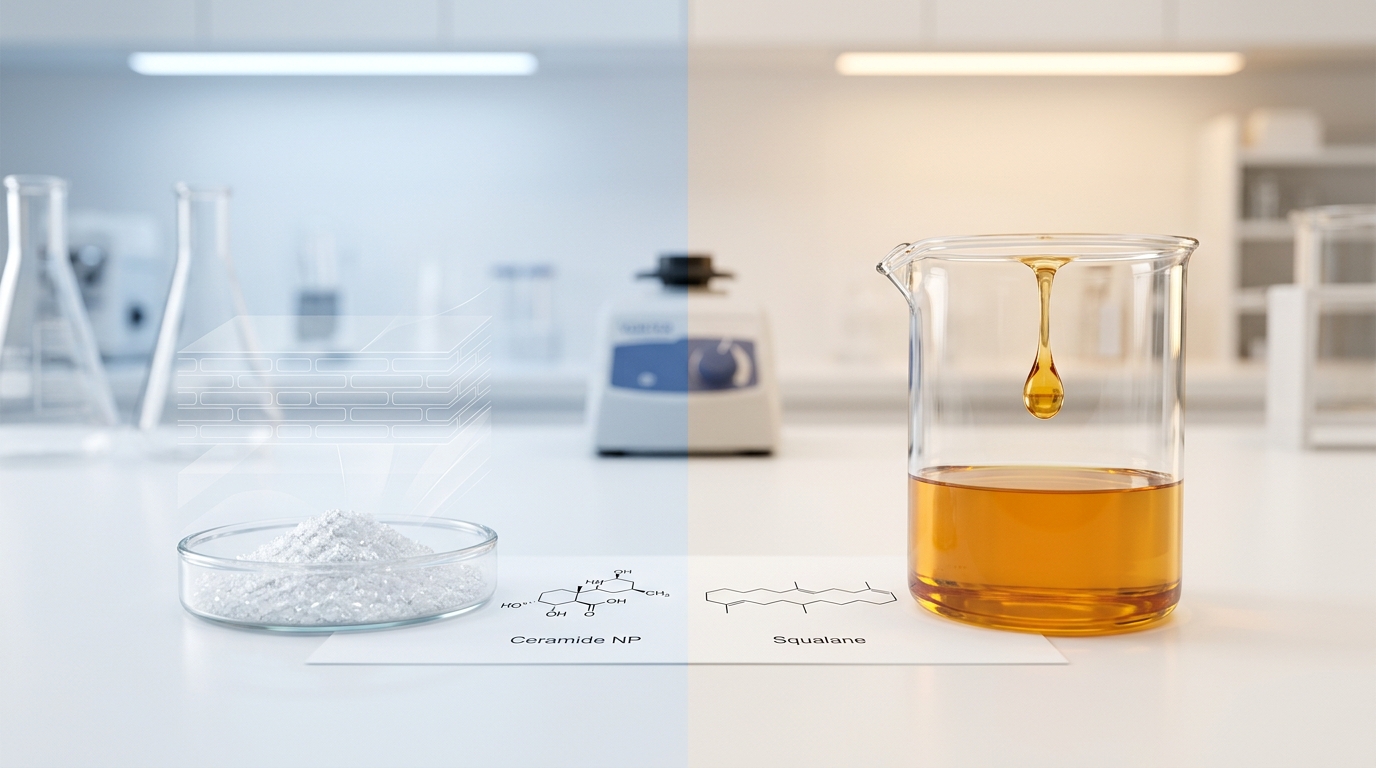
A European contract manufacturer came to us last quarter with a deceptively simple question: “We’re reformulating our barrier-repair line — should we build around ceramide NP or squalane?”
We hear versions of this question regularly. And the honest answer is almost never the one formulators expect — because ceramide NP and squalane repair the skin barrier through fundamentally different mechanisms, with different manufacturing constraints, different stability profiles, and cost structures that differ by an order of magnitude. Choosing between them is not a potency comparison. It is a formulation architecture decision.
This guide breaks down that decision from the perspective of a supplier that ships both ingredients globally — including the processing, stability, and cost trade-offs that do not appear on spec sheets.
Ceramide NP and squalane both contribute to skin barrier health, but through mechanisms so different that they effectively address separate layers of the barrier architecture. Understanding which mechanism your product needs is the first — and most consequential — formulation decision.
Ceramide NP (N-stearoyl phytosphingosine, CAS 100403-19-8 / 178436-06-1) belongs to the ceramide 3 subclass — sphingolipids that constitute approximately 50% of the stratum corneum’s lipid mass by weight (Bouwstra et al., 1997, J Lipid Res). Unlike most cosmetic actives that deposit on or penetrate through the skin, ceramide NP is designed to integrate into the skin’s existing lipid architecture.
The stratum corneum’s barrier function depends on a highly organized lamellar bilayer structure — alternating layers of lipids arranged in a “bricks and mortar” model, where corneocytes (bricks) are held together by an intercellular lipid matrix (mortar). Ceramide NP, when correctly formulated, slots into this lamellar arrangement, restoring structural integrity from within.
The critical qualifier is “when correctly formulated.” Research from Mao-Qiang et al. (1993) demonstrated that applying ceramides alone — without cholesterol and free fatty acids in an appropriate molar ratio — can actually delay barrier recovery rather than accelerate it. The lipid matrix requires all three components to form functional lamellar structures. Applied in isolation, ceramide NP produces abnormal lamellar bodies and a structurally imbalanced matrix (Man et al., 1993, Arch Dermatol, 129(6):728-738, DOI: 10.1001/archderm.1993.01680270068009).
This has direct procurement implications: sourcing ceramide NP is only half the formulation equation. You also need pharmaceutical-grade cholesterol and appropriate free fatty acids, and the manufacturing process to combine them correctly.
Squalane (C₃₀H₆₂, CAS 111-01-3, MW 422.83 g/mol) is a fully saturated hydrocarbon derived from hydrogenation of squalene — the same lipid produced naturally by human sebaceous glands. It functions through an entirely different barrier-repair mechanism than ceramide NP.
Rather than integrating into the lamellar bilayer, squalane forms a protective occlusive film on the skin’s surface. This film reduces transepidermal water loss (TEWL) by physically slowing water evaporation — not by rebuilding the structural matrix, but by shielding it. Think of it as waterproofing the roof rather than repairing the foundation.
Squalane’s compatibility with human sebum gives it excellent sensory properties: non-comedogenic at concentrations up to 100%, lightweight, and rapidly absorbed without a greasy residue. For formulators, this translates to a high degree of flexibility — squalane can function as the primary emollient, a co-emollient in complex systems, or a standalone product.
The structural vs. occlusive distinction is not academic. It determines formulation complexity, claim positioning, target condition, and cost architecture.
Formulation complexity. Ceramide NP requires co-formulation with cholesterol and fatty acids, controlled cooling, and specific emulsification parameters. Squalane requires none of these — it dissolves into the oil phase with no special handling.
Claim positioning. A ceramide-based formula can support claims around “barrier repair” and “structural restoration.” A squalane-based formula supports “moisture lock” and “protective barrier” claims. The distinction matters for regulatory and marketing teams.
Target condition. Compromised barriers with clinically damaged lamellar structure (atopic dermatitis, post-procedure recovery) benefit more from the structural approach. Mildly dry or dehydrated skin, or skin exposed to environmental stress, responds well to occlusive protection.
Cost architecture. The mechanism difference maps directly to a 10–50× difference in raw material cost per kilogram — a gap we address in detail below.
The physical state difference at room temperature — crystalline powder vs. liquid oil — drives nearly every downstream processing distinction between these two ingredients. Here is what matters for your manufacturing line.
| Property | Ceramide NP | Squalane |
|---|---|---|
| CAS Number | 100403-19-8 / 178436-06-1 | 111-01-3 |
| Molecular Weight | 581.95 g/mol | 422.83 g/mol |
| Appearance (25°C) | White to off-white crystalline powder | Colorless, odorless liquid |
| Melting Point | ~130–140°C (solid at RT) | −38°C (liquid at RT) |
| Density | 0.982 g/cm³ | 0.810 g/mL |
| Solubility (water) | Insoluble | Insoluble |
| LogP (predicted) | ~11.79 | ~14.1 |
| pH Stability Range | Stable pH 4.0–8.0 | pH-independent (hydrocarbon) |
| Oxidation Susceptibility | Minimal (saturated sphingoid base) | None (fully saturated C30) |
| Typical Use Level | 0.5–3.0% | 2–15% (up to 100% in oils) |
Ceramide NP’s high melting point (~130–140°C) means it must be dissolved into the formulation at elevated temperatures (75–80°C) during the emulsification step. This is standard practice. The challenge emerges during cooling.
Uncontrolled cooling allows ceramide NP molecules to form large, unstable crystals — visible as gritty particles in the finished product. These large crystals do not integrate into the lamellar bilayer and can destabilize the emulsion system over time. The target is crystal size below 10 μm, achieved through a controlled two-stage cooling protocol:
We have seen this crystallization challenge firsthand in cold-chain logistics. One European client received a ceramide NP shipment that tested fine at our Wuhan facility (warehouse at ~15°C), but showed visible crystal formation upon arrival after winter transit through a sub-zero temperature zone. The raw material’s integrity was unaffected — the crystals dissolved normally during formulation — but the visual appearance triggered a quality hold and delayed their production schedule by a week. We now recommend including a pre-dissolution protocol note with every ceramide NP shipment destined for cold-climate warehouses.
Squalane, by contrast, has a melting point of −38°C. It remains liquid under any realistic storage, shipping, or processing condition. No crystallization risk, no cold-chain concerns, no dissolution step required. You open the drum and pour.
Ceramide NP in emulsion systems increases formulation viscosity — typically from a baseline of 2,000–3,000 mPa·s to 4,000–6,000 mPa·s at use levels of 1–3%. This viscosity increase is not always unwelcome (it can contribute to cream richness), but it constrains formulation flexibility. A lightweight serum or lotion texture becomes difficult to achieve with ceramide NP at efficacious concentrations.
Higher viscosity also affects manufacturing: filling nozzle calibration, de-aeration cycle time, and pumping requirements all change. A formulation developed without ceramide NP that adds it in a line extension may require process re-validation.
Squalane at typical use levels (5–10%) has a neutral to slightly reducing effect on emulsion viscosity. Its low viscosity (31.1 mPa·s at 25°C) and excellent spreadability mean it can be added to or removed from a formulation without significant rheological adjustment. For brands extending an existing line with a “barrier-repair” variant, squalane offers a lower reformulation burden.
The most significant formulation distinction between these two barrier lipids is not their efficacy — it is how much engineering your production line needs to deliver that efficacy consistently at scale.
Optimal barrier repair requires ceramides, cholesterol, and free fatty acids in an approximately equimolar ratio — commonly cited as 3:1:1 (ceramides:cholesterol:FFA) (Mao-Qiang et al., 1996; Schild et al., 2024, Int J Cosmet Sci, DOI: 10.1111/ics.12972). Formulating ceramide NP without this lipid trio does not merely reduce efficacy — it can actively impair barrier recovery.
Practical formulation protocol:
This is a non-trivial manufacturing process. The equipment, temperature control, and QC capability required are significantly beyond what a standard emulsion demands.
Squalane integrates into formulations with essentially no constraints:
No co-ingredients required. No molar ratio dependencies. No crystallization protocol. No specialized equipment beyond standard mixing.
Many formulators want the best of both mechanisms: ceramide NP for structural repair and squalane for occlusive protection. This combination is viable — but not without qualification.
Our formulation team has observed that squalane at high concentrations (above approximately 5–10% in the total formula) can interfere with ceramide NP’s lamellar self-assembly. The mechanism is intuitive: squalane’s linear hydrocarbon chains compete with the organized packing of ceramide NP’s sphingoid base, cholesterol, and fatty acids. At moderate squalane concentrations (2–5%), this interference is minimal. At higher concentrations, the lamellar organization becomes progressively disrupted.
| Formulation Type | Ceramide NP % | Squalane % | Rationale |
|---|---|---|---|
| Barrier-repair cream (ceramide-forward) | 1.5–3.0% + cholesterol + FFA | 2–3% | Ceramide does structural work; squalane provides surface seal without disrupting assembly |
| Lightweight emollient lotion (squalane-forward) | 0.5–1.0% + co-lipids | 5–8% | Squalane drives texture and occlusion; ceramide provides baseline structural support |
| Intensive overnight treatment | 2–3% + co-lipids | 3–5% | Balanced approach for maximum claim flexibility; controlled cooling essential |
For a deeper look at multi-lipid combination strategies including HA and panthenol, see our Synergizing Ceramides, Squalane, HA, and Panthenol guide.
Need help optimizing a ceramide + squalane dual-lipid system for your specific emulsion architecture?
Both ceramide NP and squalane are inherently stable molecules — neither is prone to rapid degradation under normal storage conditions. But their stability failure modes are entirely different, and understanding where each ingredient is vulnerable determines your accelerated testing strategy and cold-chain requirements.
Ceramide NP: The primary stability risk is physical, not chemical. Crystallization during cooling or cold storage produces visible particles, texture changes, and potential phase separation. Accelerated stability testing at 40°C/75% RH typically shows ceramide-containing emulsions maintaining specification for 12+ months — the challenge is the low-temperature end, not the high-temperature end.
Squalane: As a fully saturated hydrocarbon, squalane has no double bonds susceptible to oxidation — a critical advantage over its unsaturated precursor, squalene. Squalane shows no meaningful degradation across the standard accelerated stability window (5–40°C, up to 75% RH). Its primary stability concern is contamination: trace squalene remaining from incomplete hydrogenation can oxidize, producing off-odors. This is a raw material quality issue, not a formulation stability issue.
Onerchem ships ceramide NP to clients across four continents. In our experience, the ingredient itself is robust — but the perception of quality during transit creates real procurement friction.
The crystallization incident described earlier illustrates a broader pattern. Ceramide NP powder that arrives with crystal structure changes from temperature cycling during shipping looks different from the sample the client approved. Even when dissolution testing confirms the material is within specification, the visual discrepancy triggers quality holds, re-testing requests, and production delays.
Our current practice: for shipments to regions with sub-zero winter transit temperatures, we include a pre-dissolution protocol guide and a note explaining expected appearance variation. This has reduced quality-related delays by approximately 70% over the past year, though it remains an area where ceramide NP’s physical properties create supply chain friction that squalane simply does not have.
Squalane ships as a liquid at any temperature above −38°C. We have never received a temperature-related quality complaint on a squalane shipment.
| Parameter | Ceramide NP (in emulsion) | Squalane (in emulsion / neat) |
|---|---|---|
| Typical shelf life claim | 24–36 months (when crystallization is controlled) | 24–36 months (limited by emulsion system, not by squalane) |
| Primary failure mode | Crystallization / phase separation at low temperature | Oxidation of trace squalene impurity (rare in high-quality grades) |
| Accelerated stability (40°C/75% RH) | Generally stable; viscosity may shift over time | Stable; no color or odor change |
| Freeze-thaw cycling | Risk factor — crystal formation on thaw | Passes standard 5-cycle testing with no change |
| Photostability | Stable (no chromophores) | Stable (no chromophores) |
The price differential between ceramide NP and squalane is the single largest practical factor in formulation decisions — and it is often larger than formulators initially expect. Here is how the economics break down at production scale.
| Cost Factor | Ceramide NP | Squalane |
|---|---|---|
| Estimated price range | $180–1,200/kg (cosmetic grade) | $15–80/kg (cosmetic grade) |
| Price driver — high end | Synthetic/fermentation-derived, >99% purity, GMP | Olive-derived, premium positioning |
| Price driver — low end | Plant-extracted (wheat/rice), lower purity | Sugarcane-derived, commodity volume |
| MOQ sensitivity | High — small-batch pricing significantly higher | Moderate — commodity pricing at moderate volume |
| Price trend | Declining (more suppliers, improved fermentation) | Stable (established commodity market) |
The cost gap exists because of fundamentally different production economics. Squalane is produced by catalytic hydrogenation of squalene — a commodity process with established scale from sugarcane or olive sources. Ceramide NP requires either fermentation (yeast-based biosynthesis) or multi-step chemical synthesis, with stringent crystallization control and purity requirements. The production complexity directly maps to cost.
Raw material cost per kilogram is misleading without accounting for use concentration and co-ingredient requirements.
| Cost Component | Ceramide NP Formula | Squalane Formula |
|---|---|---|
| Active ingredient per 50 mL unit (@ 2% / 5%) | ~$0.18–$1.20 ceramide NP | ~$0.04–$0.20 squalane |
| Required co-ingredients | Cholesterol ($40–80/kg) + FFA ($10–30/kg) | None required |
| Co-ingredient cost per unit | ~$0.03–$0.08 | $0 |
| Processing overhead | Higher (controlled cooling, viscosity adjustment, crystal QC) | Standard |
| Estimated total active cost per 50 mL | $0.25–$1.40 | $0.04–$0.20 |
Even at the lower end of the ceramide NP range, the active ingredient system costs 3–6× more than squalane per unit. At the higher end, the gap widens to 30–70×.
The cost premium for ceramide NP is justified when the product is positioned as a dermatological or clinical-grade barrier-repair treatment where structural restoration claims differentiate from competitors, the target market supports premium pricing ($40+ retail per unit), and the formulation requires documented lamellar integration for regulatory or clinical claims.
The premium is not justified when the product is a mass-market moisturizer where cost-per-unit is tightly constrained, the barrier-repair mechanism is secondary to hydration or sensory benefits, or the formulation already contains other barrier-repair actives (HA, panthenol) and squalane’s occlusive function completes the system.
Our observation, based on supplying both ingredients to formulators across market segments: approximately 60–70% of barrier-repair formulations we support use squalane as the primary lipid and reserve ceramide NP for premium or clinical-positioned products. The current understanding of barrier lipid science suggests this is a rational allocation — both mechanisms contribute to barrier health, but the clinical evidence for ceramide’s superiority over occlusion alone is stronger in compromised-barrier conditions than in routine moisturization.
Both ceramide NP and squalane enjoy broad global regulatory acceptance for cosmetic use. Neither ingredient faces concentration restrictions in any major market. The key differences lie in claims substantiation rather than permissibility.
| Market | Ceramide NP | Squalane |
|---|---|---|
| EU (CosIng) | Listed; no restriction | Listed; no restriction |
| US (FDA) | Permitted in cosmetics; CIR safety assessment (2015) concluded safe | Permitted in cosmetics; long history of safe use |
| China (NMPA) | Listed in IECIC (2021); no restriction | Listed in IECIC; no restriction |
| Japan (MHLW) | Permitted; no restriction | Permitted; no restriction |
| ASEAN | Follows CosIng/CIR precedent | Follows CosIng/CIR precedent |
| Claim Category | Ceramide NP | Squalane |
|---|---|---|
| “Barrier repair” / “Barrier restoration” | ✅ Strong — supported by lamellar integration mechanism | ✅ Moderate — supported by occlusive protection |
| “Identical to skin lipids” | ✅ Ceramides are endogenous SC lipids | ⚠ Partial — squalane mimics sebum, not SC lipids |
| “Structural repair” | ✅ Supported by published data on lamellar integration | ❌ Not supportable — squalane does not integrate structurally |
| “Non-comedogenic” | ⚠ Concentration-dependent; no broad claim data | ✅ Strong — supported at concentrations up to 100% |
| “Suitable for oily/acne-prone skin” | ⚠ Rich textures may limit positioning | ✅ Lightweight texture supports this positioning |
| “Clinically tested barrier repair” | ✅ Multiple clinical studies (with co-lipid system) | ✅ Clinical evidence for TEWL reduction |
After analyzing mechanism, processing, stability, cost, and regulatory profiles, the decision comes down to three variables: your product’s barrier-repair claim requirements, your manufacturing capability, and your cost ceiling. This flowchart captures the decision logic we walk through with our clients.
The most sophisticated barrier-repair formulations we see from our clients use both: ceramide NP (with co-lipids) for lamellar integration at the structural level, and squalane for surface occlusion at the protective level. This dual-lipid approach addresses both the “foundation repair” and “roof sealing” functions of the skin barrier.
When to combine: premium barrier-repair formulations where both mechanisms add consumer-perceivable benefit; clinical or dermatological products where maximum barrier recovery speed is the priority; products targeting multiple climate zones where squalane’s climate-independent occlusion complements ceramide’s structural function.
When to keep them separate: when cost constraints make the combined active system uneconomical; when squalane concentration would exceed the 5–10% threshold where lamellar disruption begins; when the product’s rheological target (lightweight serum, spray, toner) is incompatible with ceramide’s viscosity impact.
For detailed combination protocols including HA and panthenol layering strategies, see our complete guide: Synergizing Ceramides, Squalane, HA, and Panthenol.
Onerchem supplies both ceramide NP and squalane globally with full COA, TDS, and formulation support documentation.
You can maintain barrier-support claims with squalane — TEWL reduction data supports this. But “structural barrier repair” claims specifically require a lamellar-integrating lipid like ceramide NP. If your regulatory team needs that level of claim specificity, squalane alone will not support it. A pragmatic middle ground: use squalane as the primary emollient and include ceramide NP at the lower end of the efficacious range (0.5–1.0% with co-lipids) to maintain claim access while managing costs.
Crystal formation during accelerated stability at low temperatures (5°C or freeze-thaw cycling) is a known challenge with ceramide NP emulsions. It does not necessarily indicate product failure — the crystals typically re-dissolve when the product returns to room temperature. However, if crystals persist at 25°C or grow over time, this suggests insufficient controlled cooling during manufacturing or an emulsifier system that is not adequately stabilizing the ceramide in the emulsion matrix. Review your cooling protocol and consider adding a crystal growth inhibitor. We are able to share our recommended cooling parameters with qualified formulators — request a consultation.
From a molecular standpoint, squalane is squalane — the hydrogenated C30 hydrocarbon is identical regardless of source. Performance differences between olive and sugarcane squalane are negligible. The choice typically comes down to cost (sugarcane is generally 20–40% less expensive at volume), supply chain preferences (European brands often prefer olive for “Mediterranean” positioning), and sustainability narratives. We supply both sources.
Published efficacy data generally supports ceramide NP at 0.5–3.0% in finished formulations — always with cholesterol and free fatty acids at the appropriate ratio. Below 0.5%, the amount of ceramide integrating into the lamellar structure may be insufficient for measurable barrier-repair effects. Above 3%, diminishing returns and increased formulation complexity (viscosity, crystallization risk) make higher concentrations impractical for most applications.
This is technically challenging. Ceramide NP’s crystallization tendency and the viscosity contribution of the ceramide + cholesterol + FFA system make clear, low-viscosity formulations difficult. Microemulsion or nanoemulsion delivery systems can achieve optical clarity with ceramide NP (Güngör et al., 2019, Cosmetics, 6(3):52, DOI: 10.3390/cosmetics6030052), but these require specialized surfactant systems and processing equipment. Squalane is significantly easier to formulate into clear serums due to its liquid state and low viscosity.
Request development samples with full COA and technical documentation. Our team can help you select the right barrier-repair lipid system for your formulation architecture and target market.
Request Samples →Published by Onerchem — B2B cosmetic ingredient supplier specialising in high-purity actives with batch-verified documentation. View our full ingredient catalogue →

